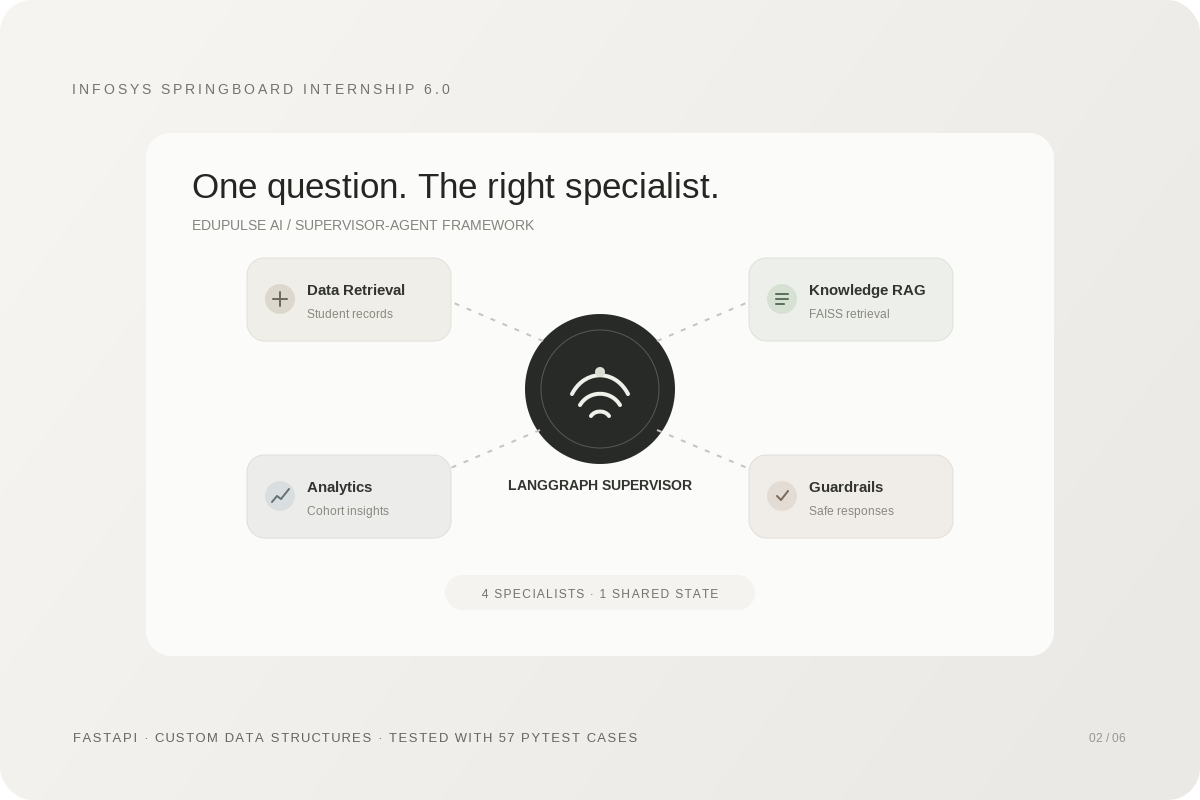
A LangGraph supervisor that routes student questions to four specialist agents.
My core deliverable for the Infosys Springboard internship: agent orchestration, semantic retrieval and custom data structures in one Python service, verified by 57 automated tests.
- Type
- Internship project
- My role
- Python & AI Intern
- Timeline
- Oct – Dec 2025
- Status
- Source code on GitHub
Results
Verified numbers
57
automated tests
4
specialist agents
7
test modules
O(1)
session cache
The problem
Infosys Springboard · Internship 6.0 · Oct – Dec 2025
An educational assistant gets very different questions: a student’s marks, a clause in the institution’s regulations, a study plan that has to fit a credit limit. One prompt handles all of them badly. EduPulse classifies each request, sends it to the agent built for it, and grounds the answer in real data: SQL for student records, semantic search for regulations. It was the assessed project for the Agent Orchestration Framework track of Springboard Internship 6.0, and I built it to be tested and deployable, not just demoable.
How it works
Simplified architecture
Client
Streamlit UI or any REST client
FastAPI service
/chat · /history · /reset · /health, Pydantic-validated
LangGraph supervisor
Structured routing, max 8 steps, LRU session state
Specialist agents
Data Retrieval
SQLite: students, subjects, marks
Knowledge RAG
FAISS over institutional regulations
Analytics
Knapsack planner, heap scheduler
Guardrails
Safety checks, AST-whitelisted maths
What I built
7 key contributions
- Architected a LangGraph supervisor that routes each turn to one of four specialist agents (Data Retrieval, Knowledge RAG, Analytics, Guardrails), built on a shared BaseAgent abstract class and factory registry.
- Engineered an O(1) LRU session cache from a hash map and doubly linked list to hold multi-turn conversation state.
- Implemented 0/1 knapsack dynamic programming for credit-constrained study planning and a heap-based priority scheduler with FIFO tie-breaking.
- Built semantic search over institutional regulations with all-MiniLM-L6-v2 embeddings and a persisted FAISS IndexFlatIP index.
- Exposed /health, /chat, /history and /reset endpoints in FastAPI with strict Pydantic validation.
- Designed a three-table SQLite schema (students, subjects, marks) with parameterized JOINs and context-managed transactions.
- Wrote 57 pytest cases across 7 modules covering API contracts, agent state transitions and AST security; containerized with a multi-stage Dockerfile and Docker Compose.
Key decisions
What I chose, and why
- Route to specialists through a supervisor
- Each request type gets an agent with the right tools, and a hard cap of 8 reasoning steps stops routing loops.
- Whitelist the AST for maths queries
- The assistant can evaluate arithmetic without ever executing arbitrary code.
- Write a custom O(1) LRU cache for sessions
- Multi-turn state stays in memory with constant-time lookups and bounded size.
- Parameterize every query and wrap writes in transactions
- Protects against SQL injection and rolls back automatically on failure.
- Load the embedding model lazily and persist the FAISS index
- The model loads only when needed and the index isn’t rebuilt on every start.
Evidence
Check the work yourself
Technology
- Python
- LangGraph
- LangChain
- FastAPI
- Pydantic
- FAISS
- Sentence-Transformers
- SQLite
- Groq
- pytest
- Docker
- GitHub Actions
Want the details behind EduPulse AI?
I’m happy to walk through the architecture, trade-offs and code in a call or interview.