A camera-based assistant that spots road hazards and announces them in five languages.
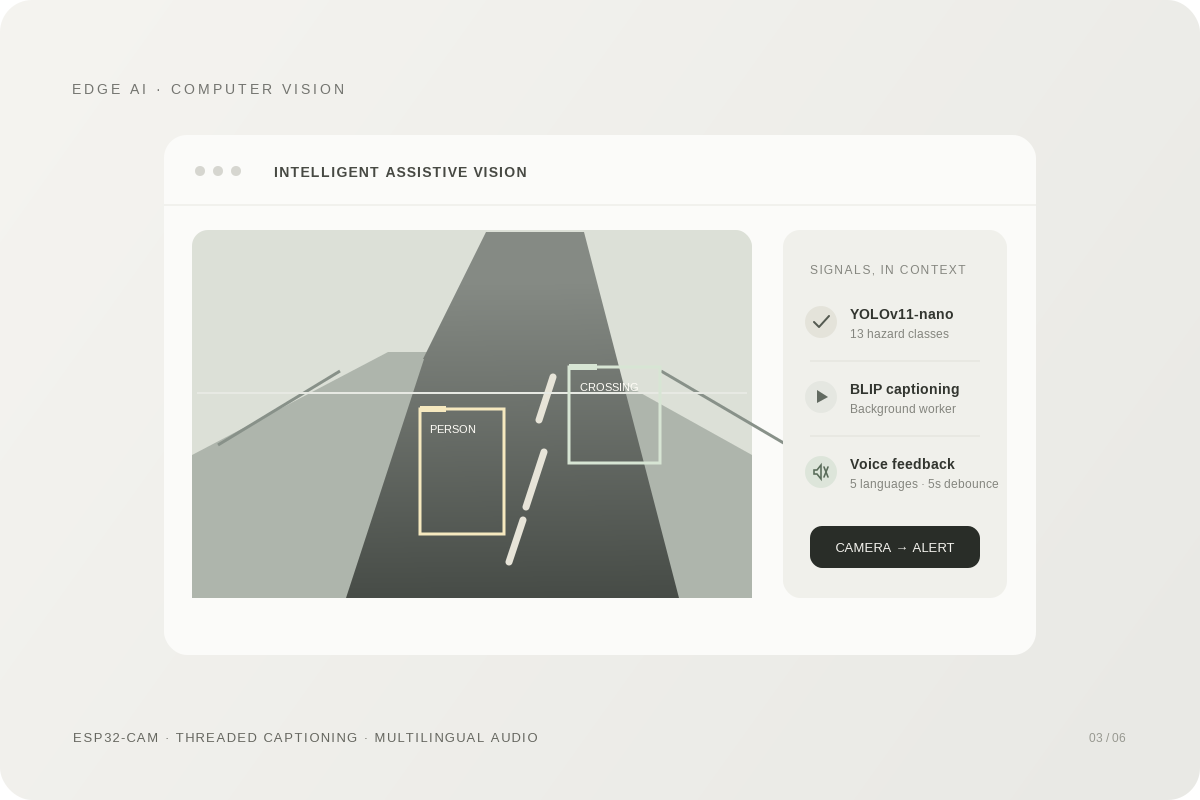
A YOLOv11-nano detector fine-tuned on 13 hazard classes, fed by a wireless ESP32-CAM, with scene captioning on background threads and spoken multilingual alerts.
- Type
- Applied computer vision
- My role
- Developer
- Timeline
- Sep 2025 – Jan 2026
- Status
- Source code on GitHub
Results
Verified numbers
3.3 ms
per frame (Tesla T4)
13
hazard classes
5
alert languages
The problem
Computer vision & hardware · Sep 2025 – Jan 2026
The system helps with pedestrian navigation. It detects hazards such as pedestrian crossings, speed breakers and school zones, describes the wider scene, and speaks alerts aloud in English, Kannada, Hindi, Tamil or Telugu. The hard constraint was latency. Scene captioning is far slower than detection, so it could never be allowed to delay a hazard alert. The project also runs on low-cost hardware: an ESP32-CAM streams video wirelessly, with its own firmware in the repository.
How it works
Simplified architecture
Camera
ESP32-CAM over Wi-Fi, or webcam
OpenCV ingest
180° rotation, per-source thresholds
Two threads
Main: YOLOv11-nano
13 hazard classes, 3.3 ms/frame on T4
Worker: BLIP
Scene captions, never blocks detection
Voice alerts
deep-translator + gTTS, 5 languages, 5 s debounce
What I built
4 key contributions
- Fine-tuned YOLOv11-nano on 13 custom road and navigation hazard classes, measuring 3.3 ms GPU inference per frame on an NVIDIA Tesla T4.
- Designed a multi-threaded pipeline that runs BLIP scene captioning on background workers so real-time detection is never blocked.
- Integrated a wireless ESP32-CAM stream with OpenCV, including 180° frame rotation and per-source confidence thresholds.
- Built spoken alerts with deep-translator and gTTS in five languages, with a 5-second debounce against repeated announcements.
Key decisions
What I chose, and why
- Run captioning on background threads
- BLIP is much slower than detection, so it runs separately and never delays a hazard alert.
- Use the nano variant of YOLOv11
- A lightweight model keeps per-frame inference fast enough for real-time use.
- Calibrate thresholds per camera
- 0.5 confidence for webcam and 0.6 for the ESP32-CAM gave stable detections on each source.
- Debounce alerts for 5 seconds
- The same hazard stays in view for many frames; without a debounce it would be announced repeatedly.
Evidence
Check the work yourself
- Source code and READMEgithub.com/Karthik-bhandarkar/Intelligent-Assistive-System
- Pipeline diagram in the repositorygithub.com/Karthik-bhandarkar/Intelligent-Assistive-System/blob/main/assets/diagrams/pipeline.svg
- ESP32-CAM firmwaregithub.com/Karthik-bhandarkar/Intelligent-Assistive-System/blob/main/firmware/ESP_CAM.ino
Technology
- Python
- YOLOv11-nano
- OpenCV
- BLIP
- Streamlit
- deep-translator
- gTTS
- ESP32-CAM
- NVIDIA Tesla T4
Want the details behind Assistive Vision?
I’m happy to walk through the architecture, trade-offs and code in a call or interview.